
Vibe Bidding
young people and your silly lingo!

Recently, the term vibe bidding has become popular at the NYC Bridge Club. With a nod to the term vibe coding, vibe bidding simply describes bidding with limited/no understanding of common bidding systems. In other words, winging it. A more complete definition:
vibe bidding
Bidding entirely naturally, off intuition, with few to no specific agreements at all.
When you get to a point in the auction that your partner and you have no specific agreements about, so you start improvising.
Incredibly creative bidding that can truly only be made up by beginner bridge players (see examples to come).

The term is usually used with a slightly negative connotation - after all, you usually don’t get to good contracts by vibe bidding - you need some set of agreements. Pure vibe bidding feels like anarchy; bridge bidding is a language that needs to be learned.
Because of the complexity of learning bidding, bridge players often follow a trajectory similar to: Learn the basics of bidding → Form a regular partnership → Work on bespoke agreements, conventions, etc. → Start winning limited events → Realize that to get to the next level, just memorizing bidding conventions won’t cut it.
Don’t get me wrong, forming solid agreements is important, especially when it comes to understanding partnership style. But when you’re spending your time memorizing a complicated relay system that comes up 0.001% of the time (and gets preempted half of those instances), the returns become diminishing.
This actually becomes a variant of that bell curve meme (see below). Early players follow their gut feeling - “vibe bidding” is their only option. Intermediate players fixate on learning the rules and conventions. It’s only until folks reach a higher level, that bidding starts to feel more like a language rather than a set of rules to memorize. After all, do you really understand what a 1♠ opening bid means intuitively? Not until you’ve played enough hands, and gain some experience.
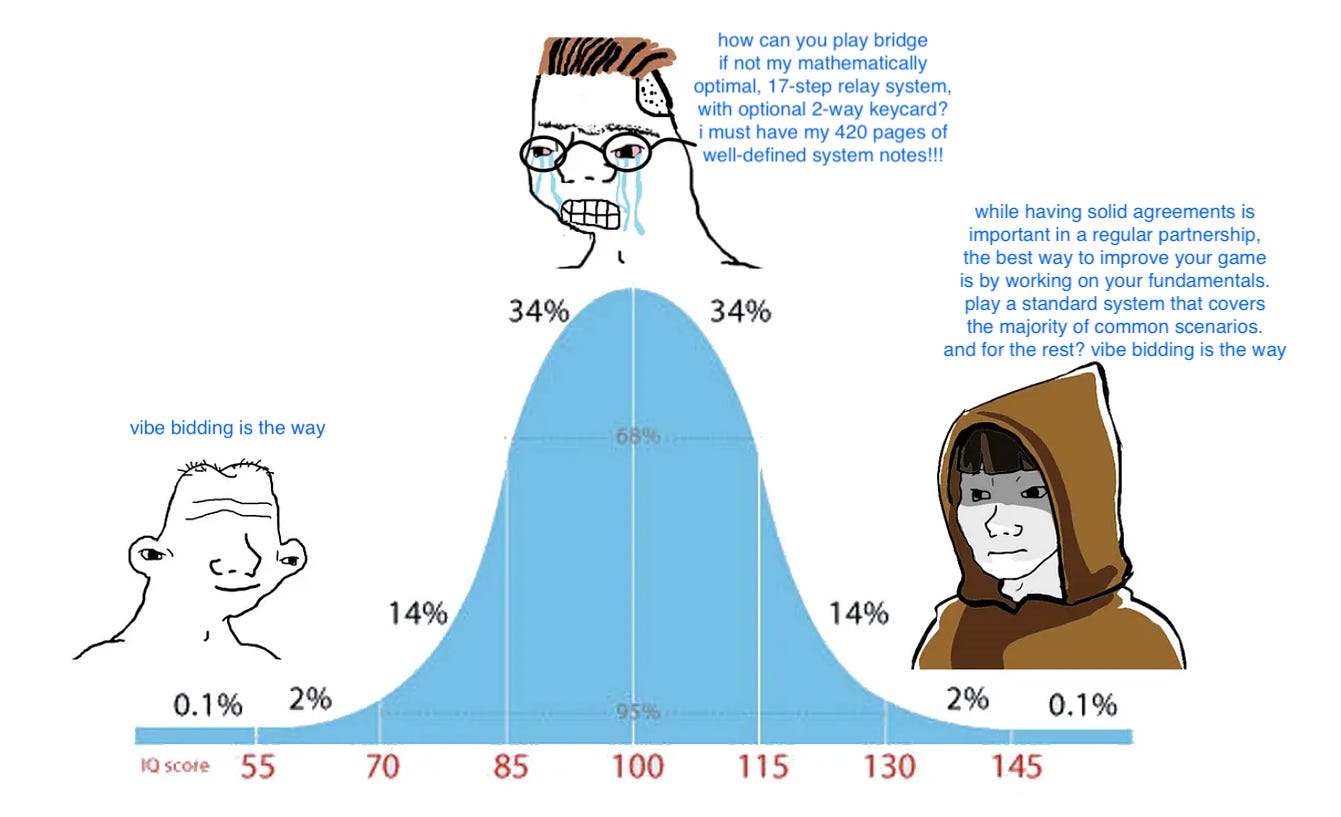
I’m not saying that bidding doesn’t matter. Borderline hands come up frequently, and judgment on them can make the biggest difference, for example, whether or not to preempt. I’m saying that system optimizations - trying to perfectly capture infinite bidding scenarios in endlessly narrowing ways - is a losing endeavor.
I’m also not saying that regular partnerships don’t matter. Knowing your partner’s specific style and having solid agreements can often help win boards and even tournaments. But even the best agreements don’t replace good fundamentals.
This might also be a personal preference. I like bridge because it’s not just a game that can be won by just memorizing a lot of stuff - that’s why I don’t play chess. I have no interest in learning a mathematically optimal system - for one, I just don’t have the time. But I do enjoy playing with various partners, it gives me a broader intuition of the game and exposes my own knowledge gaps. And it’s more fun! As a result, I often find myself embracing vibe bidding.
Vibe bidding is also an edge that human experts have over robots. Robots are great at a lot of different things, but fall short on tasks like reasoning, tempo analysis, psychological modeling, and more - effectively vibe bidding.
Finally, let’s imagine 2 advanced players playing a mathematically optimal bidding system, against 2 world class players playing a standard 2/1 card with 15 minutes of discussion. The world class pick-up partners will win almost every time. Why? Even if the advanced players reach a better contract 1% of the time, the world class players will out-play, out-defend, and out-vibe-bid them on the remaining 99% of those boards.
Enough defense of vibe bidding - let’s look at some examples.
1. Classic Vibe Bidding
This hand came up during NYC Bridge Club recently - at a table of beginner players:
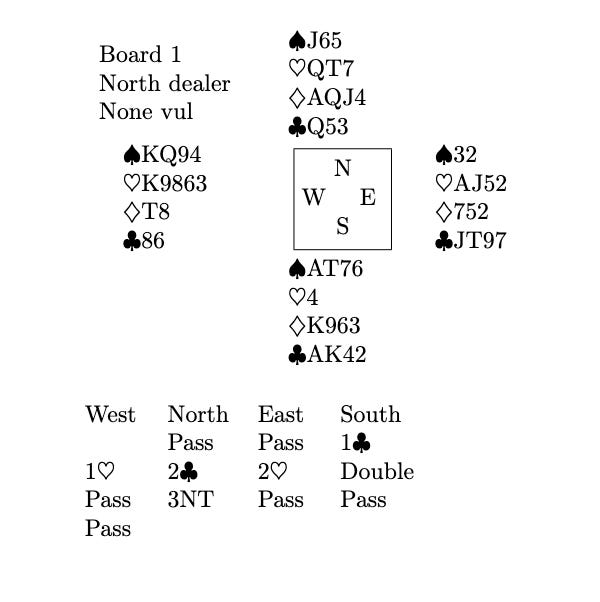
Given that these players have played less than 5 times each, and with no formal training, I’d say this is pretty reasonable beginner bidding. Sure, South should open 1♦ instead of 1♣ - but the instinct is right. North should probably bid 1NT instead of 2♣ - maybe the instinct was “raise with a 3-cards in partner’s suit” - but it worked out in the end.
The double though, is right on! I don’t think I taught them takeout doubles in this specific scenario, but my student figured it out. The 3NT is a bit aggressive, but overall reasonable as well.
The submitter of this hand commented that “We blundered our way into the right contract” - implying some defensive error to make this game!
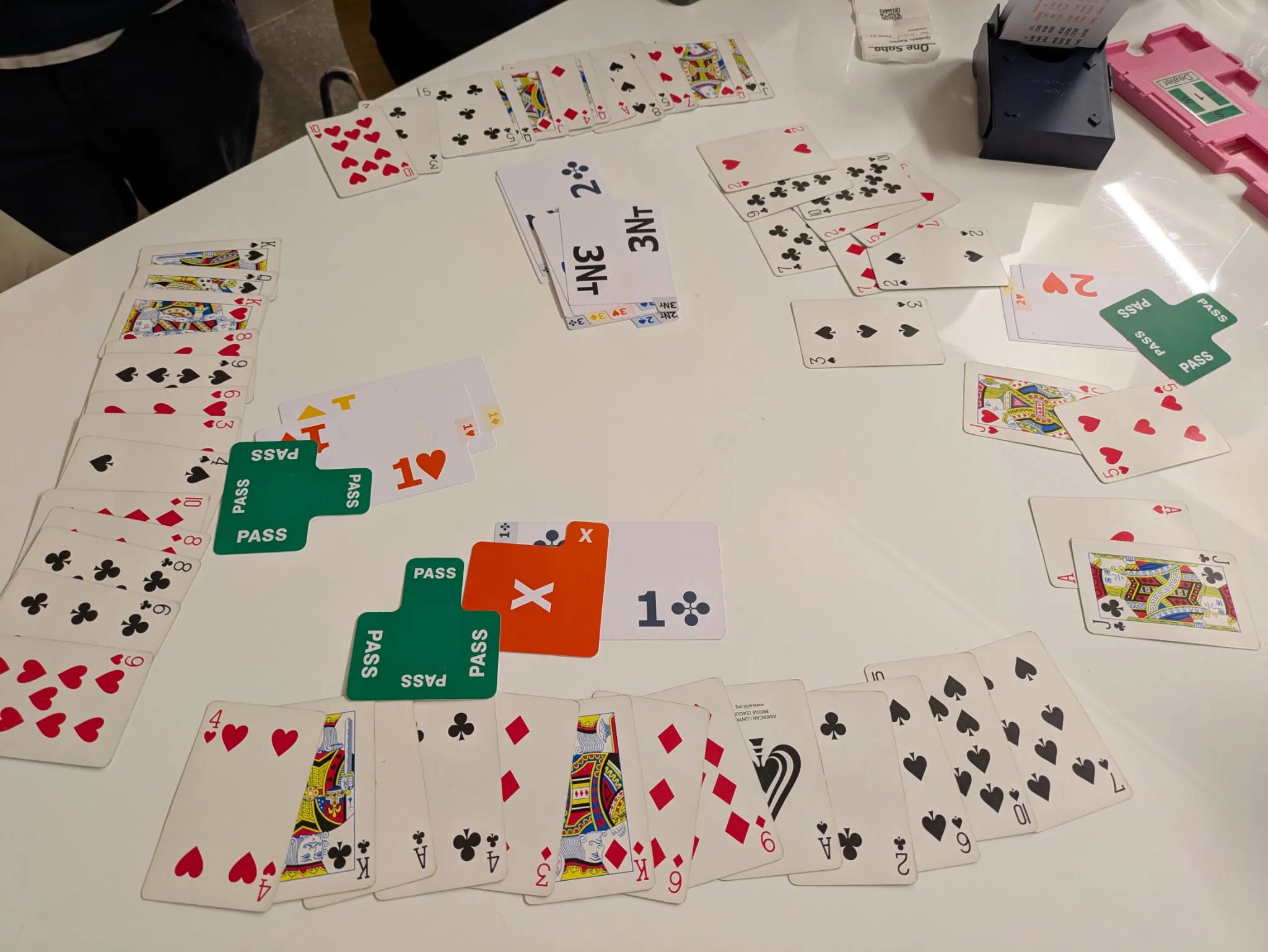
The cherry on top though, was the submission - see the picture below. The missing pass cards, the board to the side, the disorganization - a perfect representation of how it feels like to learn bridge.
2. Improvising
Next, here’s an example of improvisation from a couple weeks back, at a Wednesday night Honors game with Alex. Although we play regularly, Alex and I have only been playing for less than a year, and naturally still have gaps / undiscussed sequences. Here’s one of them.
Unfavorable, I picked up ♠9853 ♥AQ762 ♦8 ♣KT8. After passing in 1st seat, partner opened 2NT.
I responded 3♣, and was pleasantly surprised to hear partner respond 3♥. I jumped to 4♠, confirming the heart fit and making a slam try. Partner now responded 4NT.
I paused. Alex and I ostensibly play Kickback - so his response should’ve shown 4 key cards1. But this bid seemed suspiciously keycard-like, and we’ve never officially discussed this sequence.
Furthermore, this wouldn’t have been a keycard ask in any other sequence - e.g., 2NT-3♣-3♠-4♥, 1NT-2♣-2♥-3♠, 1NT-2♣-2♠-3♥. It just happened that this particular sequence looked particularly keycard-like.
I had two options: 1) Assume 4♠ was a keycard ask. 2) Assume 4NT was a keycard ask.
Option 1: If this was true, partner has shown 4 keycards, so I should confirm all keycards, make a grand slam try. Our agreement is +2 steps2, so I should respond 5♦.
Option 2: If this was true, I should respond with 5♣ to show my 1 keycard.
What should I do? I felt like it was Option 1. I couldn’t tell you - maybe we bid Kickback pretty liberally, maybe it was just the vibes.
I followed my gut instinct and bid 5♦. Partner responded 6♦, showing the ♦K.
Now I started to get greedy. I could’ve just signed off in 6♥. I had some extras, and 6NT looked pretty safe. But we do have all the keycards, and I felt like there was some hope in the grand…
What if I bid 6♠? I knew partner wouldn’t pass - we’ve confirmed that hearts are trump, and the 6♦ response made it pretty clear we’re on the same page3.
He’d know I’m stuck for a bid. I could bid 6♥ if I wanted to play there. I could bid 6NT if I wanted to play there. That weird middle bid implies…something else.
“Bid 7♥ if you think we can make it, otherwise bid 6NT 🤔” -the vibes
Fuck it. I bid it, and partner bid 7♥, ending the auction. The full hand:
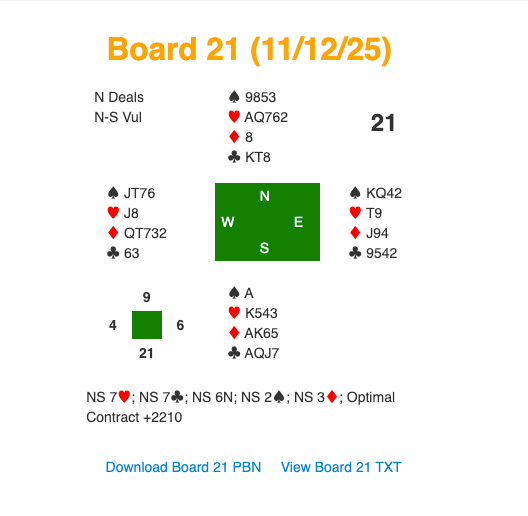
As dummy came down, Alex explaing every single one of my bids, exactly as intended. Somehow, partner was on the exact same page. Not my most scientific auction, but certainly a very satisfying moment.
3. Creativity
Finally, beginner bridge players truly come up with the most amazing, creative bids. The following message was sent to me in the NYC Bridge Club Discord, described by the author as “one of the most memorable hands [they] have played”:
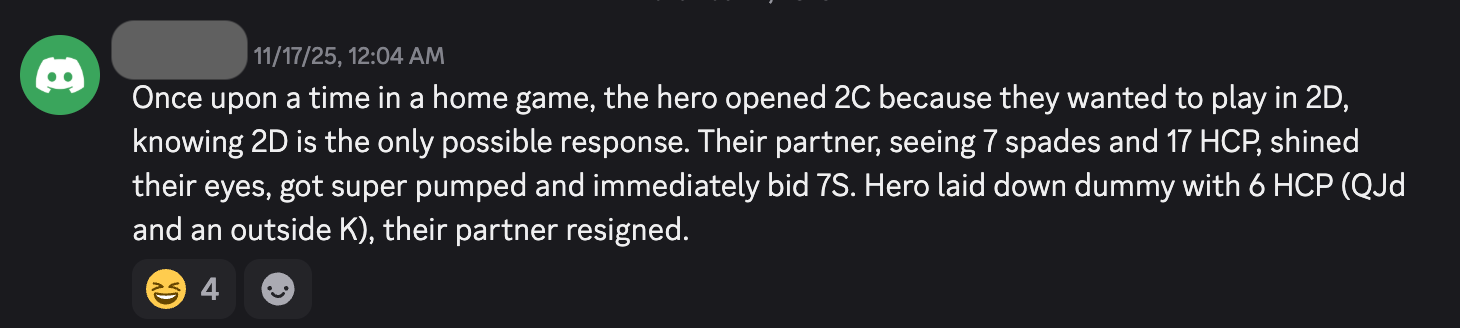
The knowledge of the “waiting” 2♦ response to the strong 2♣ opening, but the lack of knowledge of a weak 2♦ opening. The jump to 7♠ after an ambiguous 2♣ opening - such unwavering that partner certainly has their strictly 22+ point opening. Chef’s kiss.
More vibe bidding to come!
While it’s theoretically possible, if he has just 1 keycard, I’m quitting bridge.
+1 step would be the queen ask (5♣)
I guess there’s a chance he’s interpreting my 5♦ as 3 or 0 keycards, and bidding 6♦ to ask for 2nd round control in diamonds… seems unlikely. He would have to have exactly 2 keycards (interpreting my response as 3), bidding 6♦ as a grand slam try. After a 5♦ response, he should normally sign off in 5M - definitely not safe to assume I have 3 keycards.